

Quick Links
- The Irony of Writing This Post
- What a Content Pillar Strategy Actually Is
- A Real Example Before We Go Any Further
- Pillar Page vs. Blog Post: What’s the Difference?
- How to Map Your Pillars
- How to Build Your Content Pillar Strategy
- What Doesn’t Qualify as a Pillar
- Common Mistakes to Avoid
- Frequently Asked Questions
The Irony of Writing This Post
You’re currently reading a piece of cluster content. (how meta!)
This post is one of twenty articles in the Plum Good Marketing Advice Hub. Each one answers a specific question that someone in our target audience might search for. All twenty link back to service pages that represent our core topics. The Advice Hub is, structurally, a content pillar strategy in action.
I didn’t start with a whiteboard diagram. I started with one question: what do the people we want to work with actually search when they’re trying to figure out their marketing? Then we started answering those questions, one post at a time, with enough internal linking to show Google that all these pieces belong together.
That’s the whole concept. Here’s how to build one for your business.
What a Content Pillar Strategy Is
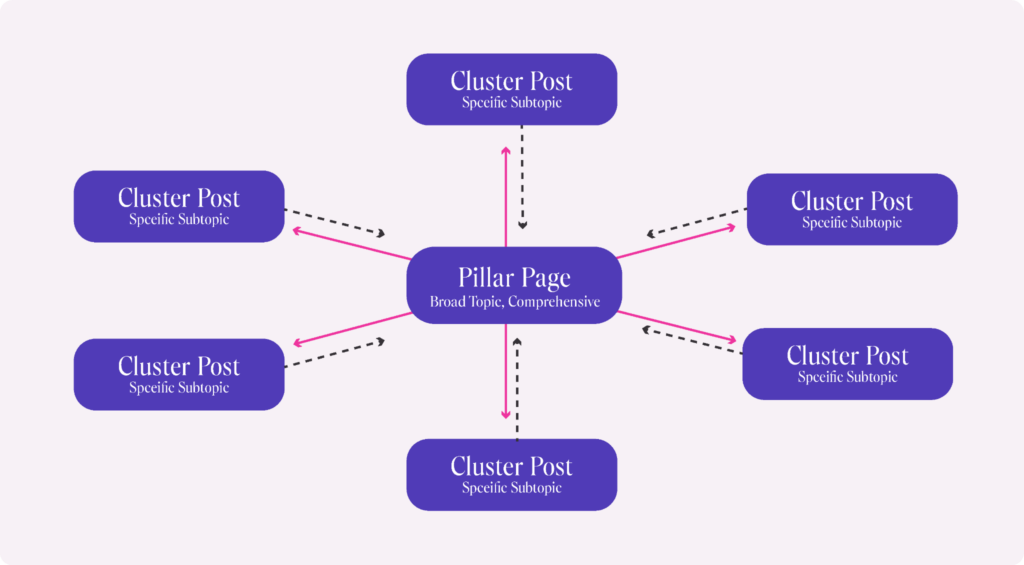
A content pillar strategy is a way of organizing your content so that everything you publish connects to a central topic, and all of that connected content points back to a core page on your site.
The “pillar” is the central page. It covers a broad topic comprehensively. The “cluster” is a collection of more specific posts, each going deep on one aspect of that broad topic. Each cluster piece links back to the pillar. The pillar links out to the cluster pieces. The whole thing creates an interconnected structure that tells search engines and AI engines that your site has real depth and authority on this subject.
The underlying logic is straightforward: Google rewards websites that demonstrate genuine expertise on a topic. A single blog post doesn’t demonstrate expertise. A pillar page with fifteen supporting posts that all link to each other does.
This matters increasingly for AI search too. Tools like Perplexity and ChatGPT don’t just pull from individual pages. They assess the depth of a site’s knowledge on a subject. A well-built content cluster signals that depth in a way that a collection of unrelated posts never will. We cover some of the technical signals that reinforce this in our guide to schema markup.
A Real Example Before We Go Any Further
Let’s make this concrete before we get into frameworks, because this is the part that actually clicks for people.

Say you’re a precision manufacturer making custom fasteners for aerospace and automotive clients. Your buyers are engineers and procurement managers. They’re not searching “custom fastener company.” They’re searching things like “custom fastener specifications aerospace,” “lead times for custom fasteners,” “difference between grade 5 and grade 8 bolts,” “fastener torque specifications,” “custom fastener minimum order quantity.”
None of those searches lead to a sale directly. They’re research queries. But they’re the questions a buyer has before they ever contact a vendor. A content pillar strategy is how you show up in those moments.
It might look like this:
Pillar 1: Custom Fastener Engineering. The pillar page covers the end-to-end process of specifying and sourcing custom fasteners. Cluster posts cover material selection, thread specifications, surface finish options, tolerance standards, how to read a fastener drawing, common specification errors, and how to avoid them.
Pillar 2: Aerospace and Automotive Fastener Standards. The pillar page covers the regulatory and technical landscape. Cluster posts cover AS9100 fastener requirements, IATF 16949 implications, NAS vs. AN specifications, traceability documentation, testing and certification requirements.
Pillar 3: Working With a Custom Fastener Manufacturer. The pillar page covers the supplier relationship from a buyer’s perspective. Cluster posts cover what to expect from a quote process, minimum order quantities, lead time factors, prototyping vs. production runs, and how to evaluate supplier quality.
Every cluster post links back to the pillar page. Every pillar page links to the core capabilities page. To Google, this site looks like the most knowledgeable source on the internet about custom fasteners for aerospace and automotive applications. Because structurally, it is.
Now you can see why we built the Advice Hub the way we did. We’re not writing about everything in marketing. We’re writing about the specific intersection of SEO foundations, content strategy, and marketing accountability that matters to the businesses we work with. That specificity is the strategy, not an accident of what we happened to feel like writing about.
As an aside – if you are actually in precision manufacturing, check out this guide on how NOT to waste your marketing dollars.
Pillar Page vs. Blog Post: What’s the Difference?
A pillar page is broad and comprehensive. It covers everything a reader would want to know about a topic from a high level. It’s longer than a typical blog post, often 2,000 to 4,000 words, and it’s designed to rank for a broad keyword phrase. Think “fractional CMO services” or “email marketing for manufacturers.” It answers the main question and gestures toward the deeper answers without exhausting any single subtopic, because that’s what the cluster posts are for.
A cluster post is specific and deep. It takes one slice of the pillar topic and covers it thoroughly. It’s designed to rank for a more specific, lower-competition long-tail keyword. It answers one narrow question completely. And it links back to the pillar page, passing authority up the chain.
From this site: our fractional CMO services page is a pillar. This post is cluster content. So is our post on setting marketing rocks, our guide to holding marketing accountable to business goals, and our piece on stopping random acts of marketing. Each goes deep on a specific problem. Each links back. Together they form the cluster.
The rule of thumb: if you can answer it fully in one post, it’s a cluster topic. If it would take a book, it’s a pillar topic.
How to Map Your Pillars
Before you write a single word, you need to know what your pillars are. Most businesses have between three and five. More than that and you’ve defined them too narrowly. Fewer than two and you’ve defined them too broadly.
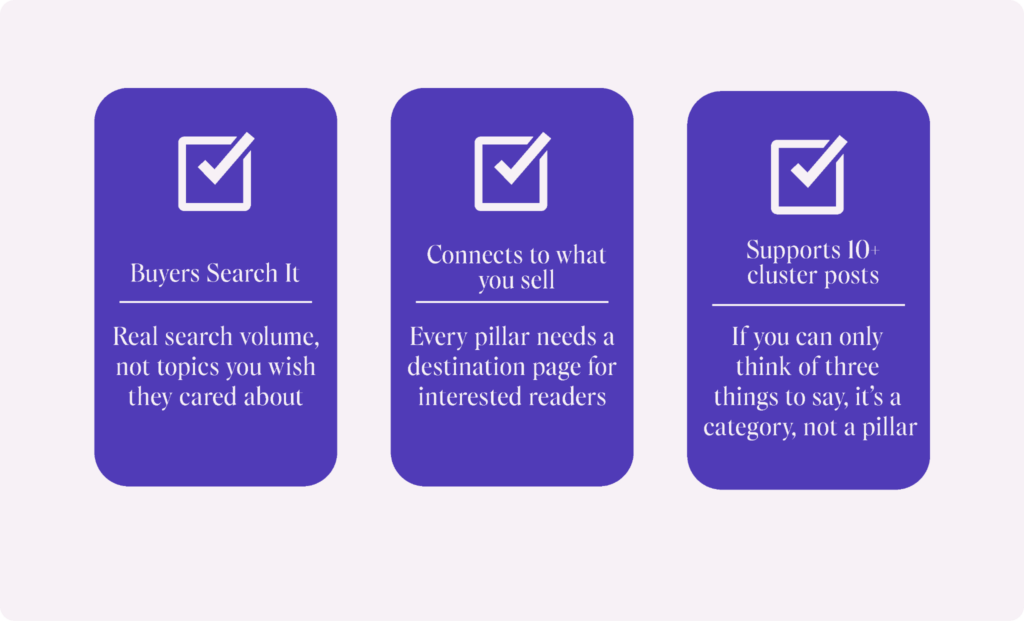
Your pillars should meet three criteria:
They represent topics your buyers actually search. Not topics you want to be known for. Topics people are already looking for help with. There’s a real difference between “we think our buyers care about supply chain resilience” and “we know our buyers search for how to reduce lead times in precision manufacturing because we checked.” Start with search intent, not internal preference.
They connect directly to something you sell. A content pillar without a service or product page to link to is an orphan. Content authority should flow somewhere useful. Every pillar needs a corresponding destination page that’s the commercial landing point for someone who has read enough to be interested.
You can realistically produce ten or more cluster posts on each one. If you can only think of three things to say about a topic, it’s not a pillar. It’s a category. Pillars are deep enough to support a full year of supporting content.
The mapping exercise looks like this in practice: write down every service or product you offer. For each one, ask what a potential buyer would search during the research phase, not the buying phase. Those search queries are your cluster topics. Group them by theme. Each theme is a potential pillar.
How to Build Your Content Pillar Strategy
This is the part that gets overcomplicated. It doesn’t need to be. Here’s the order of operations.
Start with a content audit. Before you create anything new, look at what already exists. Most businesses have blog posts, service pages, or resources that could become the foundation of a pillar strategy. A site audit tells you what’s already working, what’s orphaned, and where the gaps are. Don’t skip this step. The fastener manufacturer above might already have five useful posts sitting on their site that nobody can find because nothing links to them.
Define your three to five pillars. Using the criteria above, write each one as a broad question: “What does it mean to source custom fasteners for aerospace applications?” or “What does fractional CMO leadership actually look like?” These become the themes your pillar pages answer at the top level.
Create or designate your pillar pages. You may already have a service page that can serve as the pillar. If so, make sure it’s comprehensive enough to be the anchor. If not, build it. And be clear on what a pillar page is not: it’s not a sales page. It’s an educational resource that lives on your site and happens to connect to what you sell. That distinction matters enormously for how it performs in search.
Map ten or more cluster topics per pillar. For the fastener manufacturer, this means listing every specific question an aerospace engineer or procurement manager might have while researching suppliers. Use Google’s “people also ask” and autocomplete to find the exact language. Your buyers’ vocabulary and your internal vocabulary are often different. Use theirs.
Build your blog category structure around your pillars. Your categories should map to your pillar topics. If you have a content pillar on custom fastener engineering, you need a blog category called something like “Fastener Engineering” that houses all the cluster posts. This is structural, not aesthetic. It tells both users and search engines how your content is organized.
Wire the internal links intentionally. Every cluster post links to its pillar page. Every pillar page links to its cluster posts. Cluster posts link to each other when relevant. This is the mechanism that makes the whole system work. We cover the specifics in our internal linking strategy guide, but the short version is: content without internal links is just a collection of pages. Content with intentional internal links is a strategy.
Publish consistently and submit every post. You don’t need to build the whole cluster before you launch. Publish the pillar page first, then add cluster posts over time. Each new post strengthens the whole structure. But every single post needs to be submitted to Google Search Console for indexing after it goes live. New content doesn’t get discovered automatically. You have to tell Google it exists.
Nail the technical foundation. Your meta titles need to reflect what you’re targeting. Your meta descriptions need to earn the click. Your canonical tags need to be correct so you’re not competing with yourself. The content strategy and the technical SEO are not separate work. They’re the same work, and one without the other underperforms.
What Doesn’t Qualify as a Pillar
Most businesses err toward too many pillars, not too few. The temptation is to treat every service line, audience segment, and product category as its own pillar. The result is a content strategy spread thin across eight topics, none of which ever accumulates enough depth to signal real authority.

These are not pillars:
A single product or service without enough content depth to support it. If you can’t write ten genuinely useful cluster posts about it, it’s not a pillar. It’s a category page, and there’s nothing wrong with that. Just don’t build a strategy around it.
A topic you care about but your buyers don’t search. Your thought leadership interests and your buyers’ search behavior are not the same thing. Build your pillars around what people are already looking for, not what you wish they were interested in. The fastener manufacturer might be passionate about manufacturing process innovation. If their buyers aren’t searching for it, it isn’t a pillar.
A topic a national competitor owns completely. If a company with a domain authority of 70 and 200 posts on this subject has a five-year head start, you’re not winning that pillar. Find the niche they haven’t served. National fractional CMO competitors have EOS landing pages. None of them are writing “how to own the marketing seat in an EOS company.” That’s why we are.
Your company news. Press releases, award announcements, and event recaps don’t answer buyer research questions. They have a place on your site, but it’s not inside a content pillar strategy.
The discipline of choosing fewer, better pillars and going genuinely deep on each one will always outperform a broad approach. Five posts on a topic is noise. Twenty well-linked posts on a topic, consistently indexed, is authority.
Common Mistakes to Avoid
Building pillar pages that read like sales pages. A pillar page that’s mostly “here’s why you should hire us” will not rank. It needs to be genuinely useful educational content. The sales case is made through the depth and quality of the content, not through the language of the page.
Creating cluster posts without linking them back. The whole system works because of internal links. A cluster post that doesn’t link to its pillar contributes nothing to topical authority. Every single cluster post needs a contextual link back to the pillar, in the body of the content, not just the footer.
Treating pillar pages as one-time work. Update your pillar pages regularly as the topic evolves, new cluster posts are published, and search behavior shifts. An outdated pillar with dead links and stale information is worse than no pillar at all.
Choosing pillars by brainstorm instead of by search data. Your pillars should be grounded in what your buyers actually search. Use Google Search Console, SE Ranking, or even Google autocomplete to validate that real search volume exists before you commit to a topic. Building authority on a subject nobody searches is a significant investment with no return.
Publishing cluster posts and never submitting them. Every new post should go to Google Search Console for indexing within 48 hours of publication. This is part of the build and optimize workflow that should happen for every piece of content, every time.
Frequently Asked Questions
What is a content pillar? A content pillar is a comprehensive page on your website that covers a broad topic in depth and serves as the anchor for a cluster of more specific supporting content. The pillar page links to the cluster posts. The cluster posts link back to the pillar. Together, they signal to search engines and AI tools that your site has genuine authority on that topic.
How is a content pillar different from a blog post? A blog post goes deep on one specific question. A content pillar covers a broad topic at a high level and connects to many specific questions. A blog post is cluster content. A pillar page is the hub that the cluster lives around.
How many content pillars should I have? Three to five for most small to mid-size businesses. The goal isn’t to cover everything. It’s to build genuine depth on the topics that matter most to your buyers and connect most directly to what you sell.
Do I need a content pillar strategy if I’m a small business? If you want organic search to work for you long-term, yes. Random blog posts published without a connecting strategy accumulate without compounding. A content pillar strategy is what makes your publishing build into actual authority over time. You don’t need a large budget. You need clarity on your pillars and the discipline to publish cluster content consistently.
What’s the difference between a content pillar strategy and just blogging? Blogging without a strategy is publishing. Blogging with a pillar strategy is building. The difference is whether your content is organized around a central architecture that tells search engines what your site is genuinely about, or whether each post is a standalone effort that doesn’t reinforce anything else. The same principle that drives stopping random acts of marketing applies directly to content strategy.
How do I know if my content pillar strategy is working before I can see results? This is the real question, because organic search results lag content publication by four to twelve weeks and it can feel like nothing is happening. The leading indicators to watch in Google Search Console are impressions growing on your target pages, average position creeping upward on your target keywords, and more of your cluster posts getting indexed over time. These signals move before ranking positions move. If impressions are climbing on your pillar page and cluster posts over the first 90 days, the strategy is working. You just haven’t seen the full payoff yet. If impressions are flat or declining, something is wrong with either the technical foundation or the search intent match, and it’s worth investigating before you publish more content into a broken structure.
How long before I see meaningful traffic results? The compounding effect becomes meaningful at the six-to-twelve-month mark when enough cluster content exists to signal topical authority. The businesses that get frustrated and abandon the strategy at month three never see what month nine would have looked like.

Go back to that fastener manufacturer for a second. The engineers and procurement managers searching their specific questions right now are finding someone. That someone is ranking because they built the content structure we described above, whether they called it a content pillar strategy or not. The manufacturer who publishes a pillar page on custom fastener engineering this month and adds one cluster post every two weeks will look, to Google, like the most authoritative source in their niche by this time next year. Not because they outspent anyone. Because they showed up with depth and consistency when their competitors didn’t bother.
That’s the whole game. And it’s more available to niche B2B businesses than to anyone else, because the national competitors aren’t writing at the level of specificity your buyers actually need.
If you want help building the architecture and someone to own the strategy, that’s exactly what we do.












Read the Comments +