

Quick Links
For years, I was a “two Instagram posts a year, always from vacation” kind of person. Which is a little ridiculous, considering I run a fractional CMO firm and spend my days encouraging founders to invest in content marketing. But, last month I finally took my own advice and posted a video every single day for 30 days, a series I called “If I Was Your CMO.” If I’m being honest, it was actually my videographer Ty’s idea, and I very willingly let him talk me into it.
Founder-led video turned out to be one of the most underused trust-builders a service business has, and now I know that from the inside instead of from a slide. So, here are ten very good things I learned. I promise you, these are actually interesting, personal, and not a list of what ChatGPT thinks I should have learned for a SEO optimized listicle blog.
TL;DR : Does founder-led video work for a service business? Yes. But the ROI shows up somewhere other than how many views you got on Instagram. My videos got a few hundred (maybe a thousand if I was lucky) views each. But, I heard from a lot of really good actual humans in real life. They were exactly the potential clients and referral partners I wanted. Once my ego recovered from my videos getting a few hundred views, I was thrilled with the results.
1. Hire a video guy. You’re the founder, not an influencer.
I’m a business owner and a strategist. I am not a videographer, and every hour I would have spent going down a CapCut rabbit hole would have been an hour stolen from the work I’m uniquely good at. So I hired Ty Colombo of Colombo Productions. After a few months of working together, he suggested we try a 30 day series and then made it pretty easy to pull off. That’s not to say that it wasn’t a lot of work, but I had an expert helping me, which was invaluable. The only reason I lasted the full thirty days, was that I didn’t do it alone, and it made the videos better than anything I would have cobbled together myself. Basically, he saved my sanity and saved me from embarrassing myself by not finishing what I started. If you as a founder are going to commit to video and sustain the effort, get the production off your own plate on day one. Trying to be the strategist and the camera operator and the editor would have burned me out fast.
2. Vanity metrics lie. The right people were still watching.
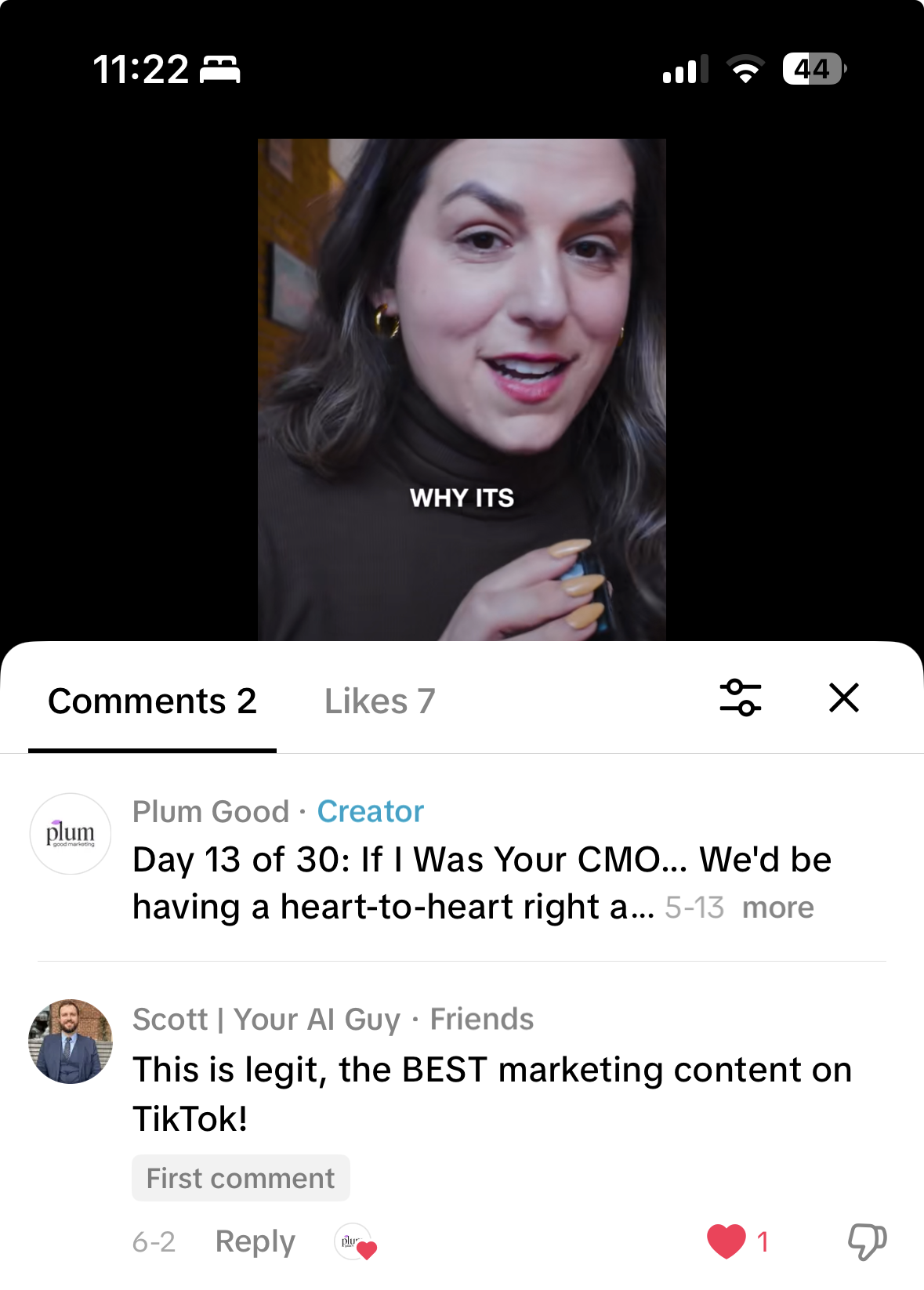
Most of these videos got a few hundred views. By the logic of likes and follower counts, that’s a flop. But, I persisted through the embarrassment and very quickly people started reaching out. And, they were business owners squarely in my target range, plus a couple of referral partners that I hadn’t heard from in a long time. And my existing clients were clearly watching. Over the month, several of them brought up my videos at least a dozen times, sometimes with startling specifics. Which was SO COOL. So, I learned that views kind of don’t matter, but what happens in real life does.
3. It warmed up my sales calls before they started.
I had a good amount of discovery calls the month I was posting the videos and the weeks following. People I’d never spoken to would show up already feeling like they knew me and trusted me, because they checked out my videos on Facebook or Instagram or LinkedIn. A video series does the trust-building on the prospect’s own schedule, before you’re ever on a zoom call together. By the time they book a call, they’ve effectively pre-qualified themselves, and the whole conversation starts several steps ahead of where it used to.
4. Prepping the videos helped me sharpen my message.
To make thirty short videos that respect people’s time, you have to know what you actually believe about your work and how to express it so people care. Getting that clear for the camera handed me language that showed up all over the business afterward, in sales conversations and in the copy on our website. I was forced to decide what I stand for and say it out loud in twenty-five seconds. If you can’t figure out your brand voice or your elevator pitch, try explaining what you do and what you think to a camera every day for a month. You’ll figure it out, fast.
5. It forced me to have a real opinion.
Safe is boring in life and on camera. If I got on and said marketing matters and consistency is key, people would scroll in three seconds, and they’d be right to do so. Some days that meant saying the thing I was a little afraid to say, like telling a whole category of business owner that the metric they’re proud of is actually working against them. But the ones I was the most nervous about were probably the ones that resonated the most with my ideal audience. Video rewards a point of view and punishes sitting on the fence. If you’re worried a take might cost you the wrong-fit clients, good. Say the thing and live your (business) truth!
6. It sorted my audience for me.
Segmentation baby! The series worked like a filter. The right people leaned in and started conversations, and the wrong-fit folks scrolled past and quietly removed themselves from my list of worries. I stopped guessing who my content was for, because the audience showed me directly. That kind of self-sorting is worth more than a bigger, blurrier following. A tight audience of people who get you will always out-earn a huge audience that doesn’t. The algorithm is a beautiful and scary thing.
7. Almost none of my competitors are doing this.
Which is pretty wild… Most fractional CMOs and service providers are still hiding behind a logo and a contact form. Maybe a headshot. But if you’re willing to put a real, opinionated human (you) on camera consistently, you stand out by default and you stick in people’s heads.
I mean, look at this! Michael Hermann, a digital marketing strategist that I know from a past life, reshared one of my videos to his own LinkedIn network and told his audience I was giving “a masterclass of high-level marketing insights,” daily, on my business page. I hadn’t heard from him in over a year, then he did this unexpectedly and we reconnected and had a great conversation over coffee.
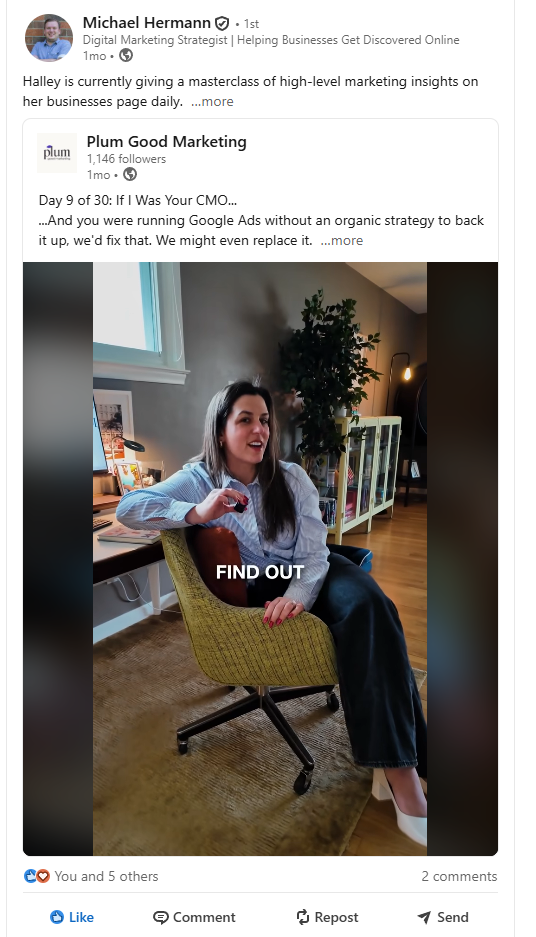
I’m not going to pretend that didn’t feel great, because it sure did. But it didn’t just feel good, it’s incredibly valuable for my brand, beyond the ego boost. When you say you’re good at your job, it’s marketing. When a fellow marketing expert says it to his own followers, unprompted, it’s credibility you can’t buy. His repost also put me in front of a whole network of people I had no other way to reach, and it framed me as the authority in the exact field I sell into. That is the entire mechanism founder video is supposed to trigger. You show up consistently with a real point of view, and eventually credible people start carrying your name into rooms you could never book yourself. Low competition plus consistency is a genuine competitive edge, and it’s sitting there unused in almost every service category.
8. We sell this. We’d better be doing it.
Sooooo, we tell clients to show up on video and build a founder-led presence, and it was long past time we practiced what we preached, ate our own dogfood and whatever other euphemism applies here. Doing the thing you sell keeps you honest, and it turns your own marketing into living proof that your advice works. Oh, and it works, cus we recommend things that are effective and should listen to ourselves! A prospect who watches a fractional CMO firm confidently nail its own content doesn’t need a case study to believe we can run theirs. If your firm recommends something it won’t actually do, that is worth some serious reflection.
9. Putting my team on camera was really important
I didn’t want this to be a one-woman show, so I got my team on video too, a few of them pretty reluctantly, but I bribed them with snacks. People hire people. Letting a prospective client see the actual faces behind the work, builds so much trust – way more than a polished headshot (or worse, a stock image) on a website. It also showed depth, that Plum is a team with range and not just a founder with a selfie stick. If you have people, get them on camera, gently and with plenty of warning.
10. None of it would have happened if I tried to make it perfect.
The whole thing only happened because I started putting videos into the world before I felt ready, and kept going when they weren’t perfect. Perfectionism is where most things, video included, goes to die, usually right around day four when the novelty wears off and the self-criticism kicks in. Done and consistent beats polished and sporadic every single time. Start a little messy. Improve in public. The businesses who win at video aren’t the most talented on camera. They’re the ones who just keep doing it.
The real reason to do any of this.
If you sell a service, people are buying the humans doing the work, and they want to know you a little before they reach out. Founder-led video lets them do exactly that on their own time, so by the time they are ready to talk to you, the trust already exists. You’ve done the hardest part of the sale before the first call.
It also absolutely feeds referrals. Every time someone watched a video, I stayed top of mind, so when a friend of theirs said “I need marketing help,” my name was the one already sitting there. The best example happened in the back half of the month. A woman I’d met at a networking event two years ago, and hadn’t really spoken to since, reached out with a referral. I can’t prove the videos caused it, but the timing wasn’t a coincidence. She’d been seeing me in her feed for weeks, and I went from a name she vaguely remembered to the marketing person she thought of first. That is what consistent visibility does. Showing up regularly is one of the simplest ways to keep a referral pipeline warm without chasing it. (More on building that pipeline on purpose here: Referrals Aren’t Free: How to Build a Successful Referral Pipeline.)
Frequently Asked Questions about founder-led video
Do you have to post a video every day? No. Daily was my own 30-day experiment. For most founders, one strong video a week is plenty. Consistency matters far more than frequency, and a pace you can actually keep beats an ambitious one you’ll quit.
Does founder video work if you only get a few hundred views? Yes. For a service business, the goal is reaching the right viewer. A few hundred of the right people can fill a pipeline, while a viral video full of the wrong people usually can’t. Judge the results by the quality of the conversations it starts, not the size of the audience.
What kind of business benefits most from founder-led video? Service businesses where trust drives the sale. Fractional CMOs, agencies, consultants, professional services, and B2B firms where the buyer is choosing a person or a team as much as a product. The higher the trust required to close, the more founder video helps.
Do you have to be on camera yourself as the founder? Starting with the founder helps, because you set the tone and the point of view. Once the series is running, put your team on camera too. Buyers want to see everyone they’ll actually work with, not only the person whose name is on the door.
What do you need to start founder-led video? Not much:
- Someone to handle filming and editing, so you can focus on showing up.
- A real point of view worth sharing.
- A posting cadence you can genuinely keep.
You can start on a phone. Production quality matters far less than showing up consistently as yourself.
How long before founder video produces results? It varies, but the early wins tend to be qualitative and fast. Warmer sales calls and unprompted reach-outs can show up within weeks. The compounding benefits, like referrals and staying top of mind, build over months of consistency.
So, should you do it?
Yeah, you should. If you’ve been telling yourself you’re not a video person, and you run a business where trust is what closes the deal, do it anyway. Start smaller than I did. One video a week, someone else on the camera, an interesting take on each one.
And if you’d rather have someone own the strategy behind all of it, that happens to be our entire job. Let’s talk.












Read the Comments +