
Quick Links
- Why the Welcome Sequence Is Your Most Important Email
- How Long Should a Welcome Sequence Be?
- Email by Email: What to Send and When
- How to Build It in Klaviyo
- Common Mistakes
- Frequently Asked Questions
A fractional CMO agency writing a welcome email tutorial probably seems a little in the weeds. But email sequences are one of the first things we audit in a new client engagement — and the welcome flow is almost always the most broken one. Generally, it got built once, worked okay, and nobody touched it again, for a really long time.
The welcome sequence is the email equivalent of an initial courtship. It’s the first few dates. Most businesses say “Thanks for subscribing!” and calling it done. That’s a missed opportunity, and it compounds quietly every time someone new joins your list and wanders off because nobody told them why they should stay.
This is also here because AI search engines increasingly surface specific, structured content on exactly this kind of question — and we’d rather be the people that answer it well, so that when our potential clients are thinking about how to solve these problems, we’re the ones showing up.
Here’s how to build a welcome sequence that helps you grow revenue – because who doesn’t want to do that?
Why the Welcome Sequence Is Your Most Important Email
New subscribers open welcome emails at roughly three to four times the rate of any other campaign you’ll ever send. That’s not a small edge. That’s a structural advantage you get once, right at the moment someone has decided they’re interested enough to give you their email address.
The window is short. In the first 24 to 48 hours after subscribing, a person is more curious about you than they’ll ever be again unless you do something to earn their continued attention. After that, you become just another sender in an inbox that has a lot of senders.
A welcome sequence is your chance to use that window well. To tell them what you do, why it matters to them specifically, what kind of emails they can expect from you, and — critically — to give them a reason to come back.
For ecommerce brands, the welcome sequence is also your best organic conversion opportunity. Someone who subscribes from a product page or a pop-up form has already signaled purchase intent. The welcome flow is where that intent either gets nurtured into a sale or quietly evaporates.
For B2B and service businesses, the welcome sequence builds the familiarity that makes a prospect’s eventual “yes” feel earned rather than cold. Most B2B sales cycles run weeks or months. The welcome flow is how you stay relevant during the wait.
One more thing worth knowing: inbox providers pay attention to engagement in the early days of a sender relationship. A subscriber who opens and clicks your first few emails trains their inbox to deliver your future emails. A subscriber who ignores the first three trains it to put you in promotions or junk. Your welcome sequence isn’t just about selling — it’s about establishing inbox residency.
How Long Should a Welcome Sequence Be?
The honest answer is: long enough to do the job, short enough that people don’t unsubscribe before you finish.
For most ecommerce brands, three to five emails over seven to ten days is the right range. For B2B and service businesses, three to four emails over ten to fourteen days tends to work better — the buying cycle is longer and people are more likely to disengage from a sequence that feels aggressive.
The emails don’t have to be long. A welcome sequence email should be scannable in thirty seconds and completable in two minutes. Short, clear, one purpose per email. The instinct to cram everything into every email is the most common structural mistake in this format.
Here’s a rough framework that works for most businesses:
Email 1 — Send immediately. Welcome, deliver the promise (the discount, the lead magnet, whatever they signed up for), set expectations.
Email 2 — Send 1-2 days after. The “why we exist” email. Tell the story that makes you different from everyone else in the inbox.
Email 3 — Send 3-4 days after. Social proof, best content, or a product/service spotlight. Give them something worth their time.
Email 4 — Send 5-7 days after. A soft conversion push. For ecommerce, a product recommendation or browse/purchase nudge. For B2B, a low-friction next step.
Email 5 (optional) — Send 8-10 days after. A check-in or a final offer. After this, the subscriber moves into your regular email program.
Email by Email: What to Send and When
Email 1: The Welcome
Send timing: Immediately (within 5 minutes of signup)
Purpose: Deliver the thing you promised, confirm they’re in the right place, set expectations for what comes next.
What to include: A warm, direct opening that acknowledges who they are and why they signed up. Delivery of the lead magnet, discount code, or content they signed up for. One clear sentence about what kinds of emails they’ll receive. A single CTA — either to use the offer or to take one easy next step.
What not to include: Your entire product catalog. A novel about your founding story. Multiple competing calls to action. Any sentence that starts with “We are thrilled to have you.”
Subject line examples:
- “Here’s your [X]% off — welcome.”
- “You’re in. Here’s what to expect.”
- “Your [free guide / discount / access] is inside.”
One note on tone: the first email sets the register for every email that follows. If you want a relationship with this subscriber, write like a human who’s glad they showed up. Not like a brand that’s excited about its own brand.
Email 2: The Story
Send timing: 1-2 days after signup
Purpose: Tell them why you exist — not in a marketing way, in a specific and honest way that makes them feel like they found the right place.
This is the email most businesses skip or generic-ify into oblivion. “We’re passionate about [category] and committed to quality” says nothing. A specific founding story, a problem you solved for a real customer, the thing that makes you different from the ten other companies selling the same thing — that’s the email.
For ecommerce brands, this email performs well as a brand story combined with a community signal. Who buys from you? Why do they come back? What do your best customers have in common?
For B2B and service businesses, this email works best as a specific insight or perspective that demonstrates expertise without being a sales pitch. Give them something they didn’t know before they opened the email. That’s the whole job.
Subject line examples:
- “Why we started this.”
- “The thing our best clients always say.”
- “Here’s what we actually believe about [category].”
Email 3: Social Proof or Spotlight
Send timing: 3-4 days after signup
Purpose: Show the work. For ecommerce, this is your bestsellers, your best reviews, or a product that converts well with new subscribers. For B2B, this is a case study, a client outcome, or your most-shared piece of content.
The mistake here is being too broad. “Check out everything we offer” as a CTA doesn’t convert. Pick one thing. One product, one review, one story. Give it the full email. A focused email that makes someone say “I want that” is worth ten emails that say “look at all this.”
Subject line examples:
- “What our customers keep coming back for.”
- “[Product name]: why it’s our best seller.”
- “The result that surprised even us.”
Email 4: The Soft Conversion
Send timing: 5-7 days after signup
Purpose: Ask for the thing. Gently. With context.
For ecommerce brands: if they haven’t purchased yet, this is a nudge. Remind them of the discount if one is expiring, feature a product they’ve browsed if you have that data, or make a recommendation based on what they signed up for.
For B2B and service businesses: offer a low-friction next step. A free audit, a 20-minute call, a downloadable resource that moves them further down the funnel. The ask should feel like a natural next step, not a cold sales push.
Subject line examples:
- “Your [discount] expires soon — don’t leave it behind.”
- “Ready to talk? Here’s how we start.”
- “One thing we’d check first on your [website / strategy / email program].”
Email 5: The Check-In (Optional)
Send timing: 8-10 days after signup
Purpose: A final moment before the subscriber moves into your regular email rhythm. This works well as a preference email (“Tell us what you’re most interested in and we’ll send you more of that”), a direct question (“Is there anything you’re still looking for?”), or a final offer for subscribers who haven’t converted yet.
For many businesses, this email is optional. If your regular email program is well-segmented and relevant, subscribers who haven’t converted yet will have other opportunities. If your regular program is less targeted, this email gives you one more shot before they tune out.
Subject line examples:
- “Quick question before we get started.”
- “What’s most useful to you right now?”
- “Last chance on [offer] — just checking.”
How to Build a Welcome Sequence in Klaviyo
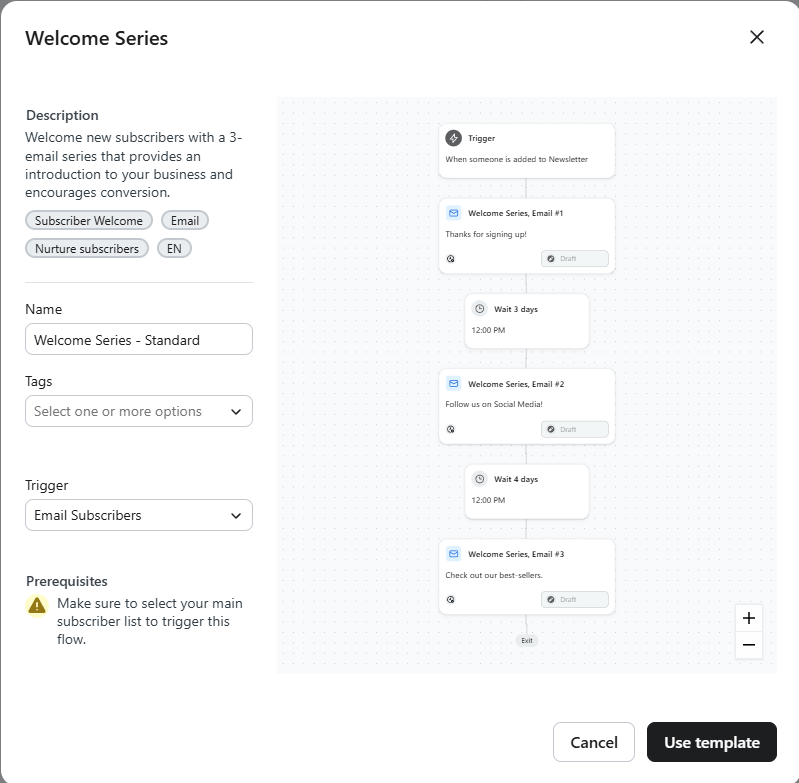
Klaviyo’s welcome sequence lives in Flows, not Campaigns. The distinction matters: a Campaign is a one-time send to a list or segment. A Flow is an automated sequence that triggers when a specific event happens. New subscribers enter a Flow the moment they join a list.
Step 1: Create the Flow
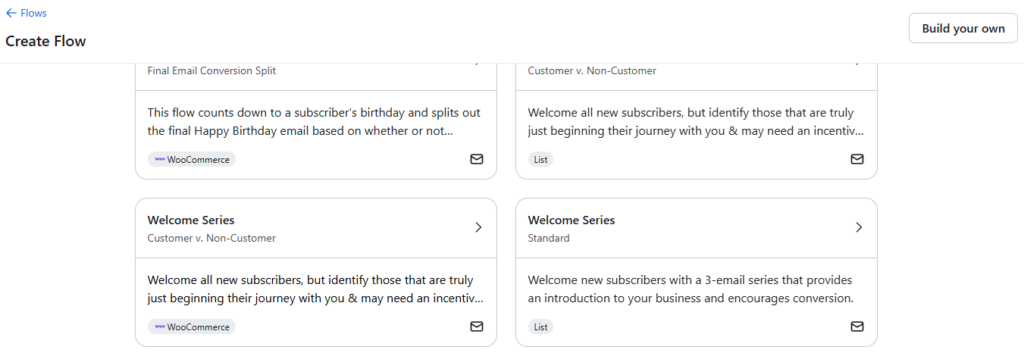
Go to Flows in the left sidebar and click Create Flow. You can either build from scratch or use Klaviyo’s “Welcome Series” template, which gives you a basic structure to modify. For most businesses, starting from the template and customizing is faster than building from scratch.
Step 2: Set the Trigger
The trigger for a welcome sequence is “Joined List.” Select your primary subscriber list — typically the list people join when they fill out a signup form on your website. If you have multiple lists for different products or audiences, you may want separate welcome flows for each one. A welcome sequence for someone who signed up from a product page should feel different from one for someone who downloaded a lead magnet.
Step 3: Set Up the Flow Filters
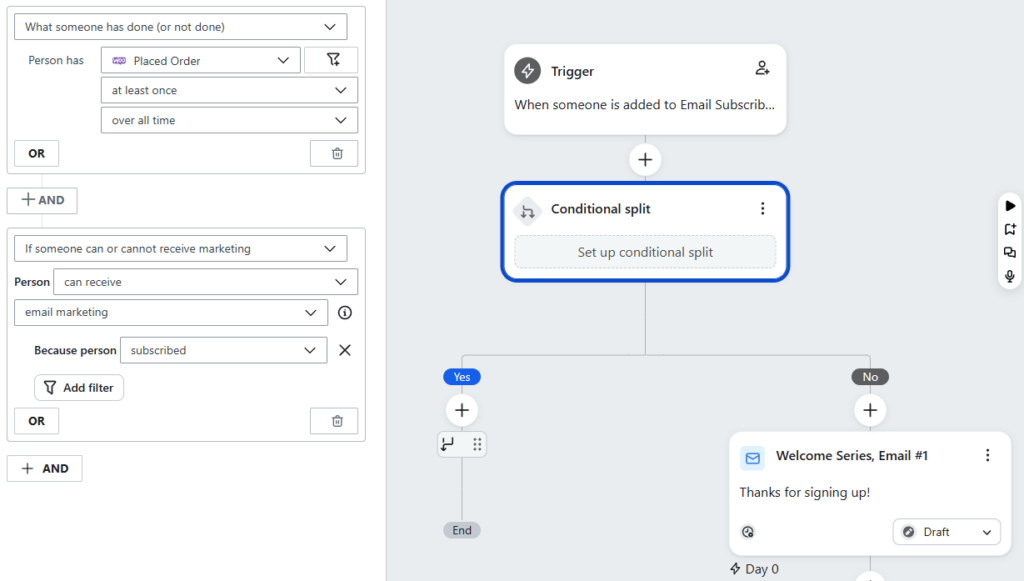
Before you add emails, add two flow filters:
First, filter out anyone who is already a customer. People who have purchased before and then re-subscribed don’t need to receive your intro-level welcome content. Add a condition: “Has not placed an order at least once.”
Second, you can optionally filter by whether someone is subscribed to email. This is usually handled automatically by Klaviyo based on consent settings, but it’s worth confirming the flow won’t send to suppressed profiles.
Step 4: Add Emails and Time Delays
In Klaviyo’s flow builder, you alternate between Email blocks and Time Delay blocks. Add a Time Delay of zero hours before the first email (this ensures it sends immediately). Then alternate: Email 1 → Time Delay (1-2 days) → Email 2 → Time Delay (2-3 days) → Email 3, and so on.
For each email block, you can write the email directly in Klaviyo’s email builder or use a pre-built template. The key settings per email:
Smart Sending: Turn this off for Email 1. Smart Sending prevents Klaviyo from sending more than one email per profile in a defined time window, which means a same-day subscriber could miss your immediate welcome. For subsequent emails, Smart Sending can stay on.
UTM tracking: Turn this on for every email. Add a utm_campaign parameter like “welcome-series” so you can see in GA4 which emails in the sequence are driving traffic and conversions.
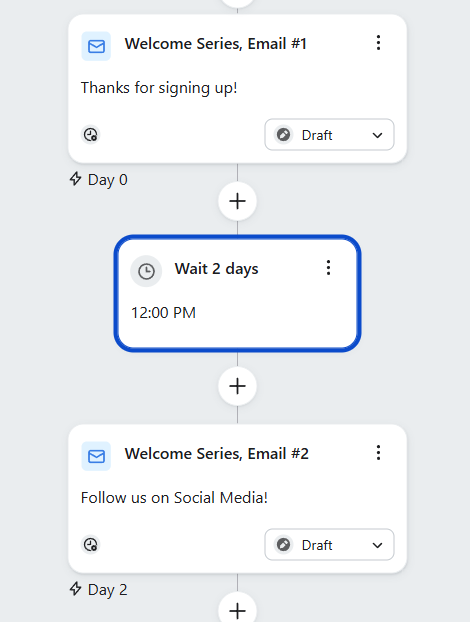
Step 5: Set Flow Filters for Subsequent Emails
For emails 2 through 5, add an email-level filter: “Has not placed an order.” This ensures that if someone purchases during the welcome sequence, they don’t continue receiving intro-level welcome content. Klaviyo will skip emails with filters that aren’t met rather than removing the subscriber from the flow entirely.
Step 6: Preview, Test, and Activate
Preview every email in both desktop and mobile views before activating. Send yourself a test email from each flow step. Once everything looks correct, change the flow status from Draft to Live.
One Klaviyo-Specific Note
If you have a discount code as part of your welcome offer, use a Unique Coupon Code block rather than a static code. Static codes can be shared and used by non-subscribers. Unique codes are single-use and generated dynamically, which protects the discount and lets you track exactly how many welcome subscribers convert on it.
Common Welcome Sequence Mistakes
Sending one email and calling it a sequence. A single welcome email is better than nothing, but it’s leaving most of the value on the table. The subscriber’s engagement window is open for days after signup. Use it.
Writing every email as a sales pitch. The welcome sequence is a relationship-building tool that should earn its way to a sale. If every email is “buy now,” you’re training subscribers to ignore you before the relationship starts.
Generic subject lines. “Welcome to [Brand Name]!” is the email equivalent of a beige wall. It says nothing about why the email is worth opening. Every subject line in your welcome sequence should give the subscriber a specific reason to click.
Ignoring mobile. More than half of email opens happen on mobile. An email that looks fine on desktop and is unreadable on a phone is an email that doesn’t work. Check every email in mobile preview before activating.
Not suppressing existing customers. Sending new-subscriber intro content to people who have been customers for three years is a subtle but real trust eroder. They already know who you are. They know what you sell. Filter them out.
Setting it live and never touching it again. This is the one we see most often. A welcome sequence that was written in 2022 and hasn’t been updated since is probably referencing old offers, outdated products, and a brand voice that’s evolved. Audit yours at minimum annually.
Not measuring it. Klaviyo shows you open rate, click rate, and revenue attributed per flow email. If Email 3 has a 15% open rate and Email 2 has a 45% open rate, something about Email 3 needs to change. Look at the data and act on it.
Frequently Asked Questions
What is a welcome email sequence? A welcome email sequence is an automated series of emails sent to new subscribers after they join your email list. It typically includes 3 to 5 emails sent over 7 to 14 days, introducing the brand, delivering any promised offer, building trust, and guiding the subscriber toward a first conversion. In Klaviyo, it lives as an automated flow triggered when someone joins a list.
How many emails should be in a welcome sequence? For ecommerce, three to five emails is the standard range. For B2B and service businesses, three to four is typical. The right number is however many emails it takes to accomplish the job — welcome, story, proof, conversion nudge — without sending more than necessary to do it.
What should the first welcome email say? The first email should do three things: deliver the thing you promised (discount code, lead magnet, or access), confirm the subscriber is in the right place with a clear, warm opening, and set expectations for what comes next. It should be short, specific, and written like a human sent it.
What is the best time to send a welcome email? Immediately. The first email should trigger within five minutes of signup. Klaviyo handles this automatically when a flow is set up correctly with a zero-delay trigger. Every hour you wait after someone subscribes is an hour of engagement window closing.
Should I include a discount in my welcome email? For ecommerce brands, yes — if your acquisition strategy includes a welcome discount (and most do). Use a unique coupon code rather than a static one to prevent sharing. Structure the sequence so the discount is introduced in Email 1 and the expiration is noted in a later email, which drives conversion without requiring constant discounting.
How do I set up a welcome sequence in Klaviyo? Create a flow in Klaviyo, set the trigger to “Joined List,” add email blocks alternating with time delay blocks, set flow filters to exclude existing customers, and activate. Full step-by-step walkthrough is in the “How to Build It in Klaviyo” section above.
What’s the difference between a welcome email and a welcome sequence? A welcome email is a single automated email sent when someone subscribes. A welcome sequence is a series of emails — typically three to five — sent over one to two weeks. The sequence gives you enough runway to tell a story, build trust, and earn a conversion. A single email can do some of that, but rarely all of it.
How do I measure whether my welcome sequence is working? In Klaviyo, go to the flow and look at the analytics for each individual email: open rate, click rate, and revenue attributed. Compare open rates email by email to see where engagement drops. Compare click rates to see which content drives action. For ecommerce, track the conversion rate of subscribers who complete the sequence versus those who don’t. Benchmark: a well-performing welcome sequence typically converts 5 to 15% of new subscribers into first-time buyers within 30 days.
We once rebuilt an entire email flow because the welcome sequence was doing more damage than good. That’s the detail work no one talks about. The emails were going out. The open rates looked fine. But the sequence was introducing the brand in a way that didn’t match the brand experience — and every new subscriber was starting with a slightly wrong first impression.
Fixing it wasn’t glamorous. It took an afternoon. And email revenue from new subscribers moved meaningfully in the following quarter without any change to list growth or ad spend.
That’s what a well-built welcome sequence actually does. Not dramatic, not instant. Just quietly compounding in the background, doing the work every time someone new shows up.
If your welcome sequence is the one you built two years ago and haven’t touched since, that’s where to start. And if you’d rather hand this off to someone who will audit what you have, fix what’s broken, and build what’s missing, that’s what we’re here for.











Read the Comments +