
Quick Links:
- Designing Paid Social Creative With Intent
- Top of Funnel: Stop the Scroll and Explain Fast
- Middle/Bottom of Funnel: Build Confidence, Not False Urgency
- A Creative System That Scales
- What This Means for Our Client
If there’s one thing I know about social ads, change is constant. Platforms change, algorithms change, formats change, and a lot of the tactics that used to work over time don’t seem to much anymore.
We were asked to step in to help manage Meta Ads for HSP Diesel while their in-house marketing coordinator was out on maternity leave. Taking on this initiative made us extremely excited as it was a chance to get closer to a brand that really understands their customers and takes pride in the quality of their products.
Even better – when she returned, HSP asked us to continue managing paid social media so she could hop back in and focus more on graphic design, email marketing, and product photography.
This is a prime example of why having a fractional CMO works so well. Everyone can focus on what they do best, and our clients benefit from having experts in the right roles at the right time.
We had a very strong Q4, and instead of keeping everything to ourselves, we figured we could share a bit of the story on how we got there to show what actually worked, what we learned along the way, and a few things to focus on when running Meta ads in this day and age.
Feel free to run with any of these suggestions in your own Meta ads efforts!
All-in-all, the biggest thing we learned from working on HSP Diesel’s account is actually very simple – but it’s something that brands miss all the time… CREATIVE MATTERS. (And more importantly, the right creative matters at particular points in the customer journey & funnel)
Designing Paid Social Creative With Intent
Before we even started to speak about creative formats, placements, or metrics, we needed to align on our intent. What are we trying to do here?
Think about it… someone who sees an HSP Diesel ad for the first time is likely in a completely different headspace than someone who is familiar with the brand (ie. seen a video, been to the website, etc.) Treating those people the same is one of the fastest ways to burn a budget without learning anything useful. And then, we have low ROAS and everyone is sad and stressed.
So we built creative intentionally around two main stages of the funnel.
At the top of the funnel, our ads are focused on introducing the brand to people who have never seen it before. These users aren’t familiar with HSP Diesel, so they do not necessarily have trust for the brand yet. These potential customers are in the awareness phase and need to be drawn in.
In the middle of the funnel, we’re targeting users who have already engaged with HSP (seen an ad, followed the account, been to the website, etc.) These users already know HSP Diesel. They just need to be woo-ed. They’re in the consideration phase and need reassurance to go ahead and make a purchase.
These breakouts are what helped craft our creative decisions going forward.
Top of Funnel: Stop the Scroll and Explain Fast
At the top of the funnel, our primary goal wasn’t to educate the users; rather it was to provide them with awareness that HSP Diesel exists and clarity on who they were.
From a targeting perspective, we focused heavily on broad targeting and leveraging the Advantage+ Shopping objective to give Meta room to find the right people, but our creative still had to catch the eye of our potential customers. We consistently noticed that two specific creative formats are what worked best here:
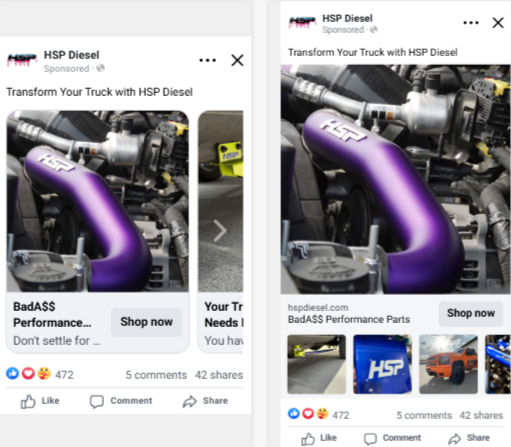
First, static product images and lifestyle images with on screen text overlays.
Showing value immediately is an extremely effective approach, and what better way to do so by having huge letters on screen essentially screaming at you. The goal here is to run with something that is clean, simple, clear, and direct response focused. People like simple… and for users that don’t know about the brand yet, it’s important to keep things clean, yet also attention grabbing.
Second, short-form video.
Speaking of keeping things simple… we also noticed that running with short videos (roughly five-fifteen seconds long) performed best. The key here is to leverage an attention grabbing hook within the first two seconds of the video to get the viewer interested and have them keep watching (then ultimately click and purchase!) These videos typically were UGC / talking head style showing the product installed or in use. This ultimately removes confusion right away and makes the value clear without explaining too much.
I also feel that this is where investing in video really starts to show a difference. HSP Diesel brought on Ty Colombo as their in house video guy (shoutout Ty!), and it has helped tremendously. We’re not just saying that because we found and recommended him 🙂 Having a skilled and strategic video guy readily available to come up with concepts, shoot, edit, etc. gave paid social a lot of fast opportunity when it came to being able to test creative quickly.
We’ve found that companies that invest in video almost always win in this world. (And no… not because video is “trendy”), but because it lets you show the product doing exactly what it’s designed to do instead of trying to explain it in a caption and hoping that users are actually taking the time to sit there and read it. (Let’s be honest, most people don’t have that kind of time or attention span…)
Below are some static designs we ran with that performed very well:
Middle/Bottom of Funnel: Build Confidence, Not False Urgency
The moment users move into the middle/bottom of funnel, performance shifted a bit (and so does strategy)
These audiences included website visitors, email signups, video viewers, social engagers, and lookalike audiences built from all those. Since all these people are (somewhat) familiar with the brand, the creative then needs to take charge and do something different. It needed to be efficient.
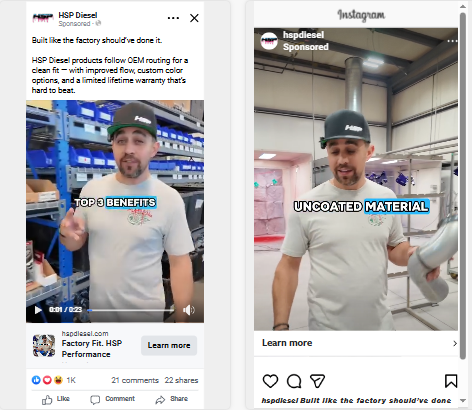
We found that educational videos that show benefits consistently performed best. This is pretty much content that explains why HSP Diesel products are different – which is something that typically these users are asking in their heads. (ie. “Okay cool so I’ve seen this company before… looks kinda cool… But why the heck do I want to buy from them? How are their products different from every other ad I see on here?”) So we went ahead and ran with videos that showed stuff like factory-style routing with improved flow, custom powder coating option – leveraging benefits like limited lifetime warranty, etc.
Now, static images still mattered here, but their role changed a bit. Instead of grabbing attention, they were designed to help instill trust. The messaging was crafted around build quality, performance improvements, and long-term reliability. Keeping the brand top of mind was extremely important.
At this point, we wanted to make the purchase decision obvious, rather than trying to pressure someone or create false urgency.
Here’s a screenshot example of a top performing video that we ran with over the last three months:
A Creative System That Scales
There was one thing that became very clear as we continued to scale and run these campaign funnels…
There is no single winning ad.
The strongest results typically came from running static images and videos simultaneously and testing variations at the messaging level – usually from the initial hook or headline while keeping the visuals consistent. What changed was how the ad caught the eye and the value proposition we would lead with (think – hierarchy text on screen, first 2 second hook in a video… whatever catches attention first while keeping the overall visual elements the same).
Instead of just assuming that one version of the ad would run best because of how it looks, we focused on learning which message actually resonated with our audiences. That matters more than most brands actually realize.
Then when something worked, we’d heavy up and scale it. When it didn’t, we nuked it and moved onto new concepts and testing. That’s how creative testing should work. You cannot be emotionally attached to any creative just because you think it was awesome… the ultimate goal is to yield results – long term.
It’s also really important to zoom out when reviewing performance across all funnels.
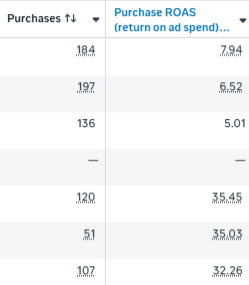
Some of the highest ROAS in this account came from middle of funnel audiences. However, in a few cases, we saw ROAS higher than 30x. That type of efficiency doesn’t happen out of pure luck or by accident… it also doesn’t always happen at the top of funnel.
Those results are possible because the top of funnel campaigns are doing their job first. TOF ads introduce the brands to prospecting audiences, set the expectations, and bring these new users into the flow. The intention of the MOF ads are to close the loop and get them to convert.
This is why we also don’t just turn off a campaign if we’re yielding only 5x ROAS (which is still an insane return) at the TOF. That ad spend is critical and setting the foundation. Without it, the high efficiency MOF performance would be non-existent.
Paid social works best when each stage of the funnel is viewed at their own level of intention – rather than an universal benchmark.
Below are some performance metrics we’ve seen over the last few months using these strategies:
What This Means for Our Client
For HSP Diesel, this approach really helped kick up performance and alignment across all marketing channels.
Instead of thinking paid social is just a short term effort, Meta became a reliable growth channel that focused on yielding new customers. That consistently carried into other areas of the business as well. As awareness increased through paid social, we saw stronger performance across other channels like Google Ads and email marketing because more people were already aware of the brand by the time they saw ads in the wild again.
Every piece of content has a clear purpose, and every message is curated to where the customer is in their journey. Top funnel creative is made to introduce the brand and get users attention. Lower funnel creative is designed to educate, reinforce trust, and help customers feel confident in their decision. Nothing is running just to “fill space” in the account… each has its purpose.
Just as important – clear reporting data gave the HSP team visibility into what was actually working and more importantly, why it’s working. This made it easier to come up with data driven decisions and scale without having to second guess any campaign or strategy.
The result is a paid social strategy that scales without having to come up with some sort of discount or just crossing your fingers hoping things work out well. Creative is intentional, tweaked based on performance, and designed to evolve as the brand grows.












Read the Comments +